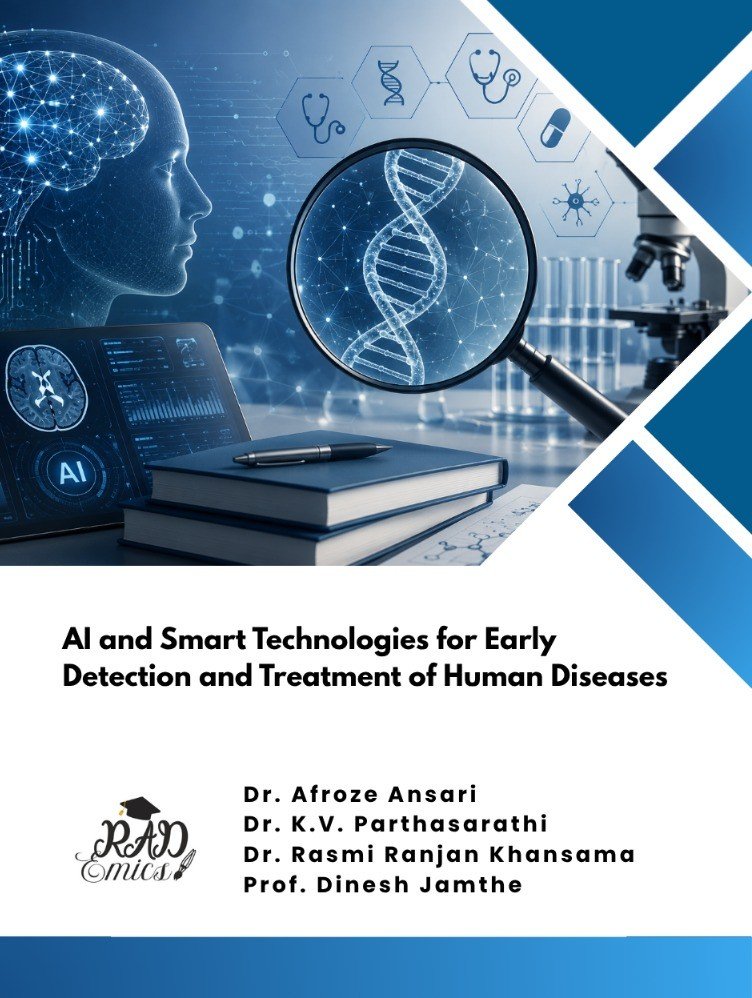
Author Name : Shaik Balkhis Banu, B. Ramana Reddy
Copyright: ©2026 | Pages: 32
Received: 02/04/2026 Accepted: 25/06/2026 Published: 25/07/2026
Artificial Intelligence (AI) has emerged as a transformative force in modern healthcare by enabling intelligent and data-driven approaches for the early prediction and diagnosis of human diseases. Rapid growth in healthcare data generated through electronic health records, medical imaging systems, genomic sequencing technologies, wearable sensors, and smart healthcare devices has accelerated the adoption of AI-based predictive analytics across clinical environments. Advanced computational techniques such as Machine Learning, Deep Learning, Artificial Neural Networks, Natural Language Processing, and Hybrid AI models provide efficient mechanisms for identifying hidden clinical patterns, disease biomarkers, and physiological abnormalities associated with chronic and life-threatening disorders. Early disease prediction through intelligent analytical systems contributes significantly toward reducing mortality rates, improving treatment effectiveness, minimizing healthcare expenditure, and strengthening preventive healthcare strategies. This book chapter presents a comprehensive exploration of AI-driven methodologies for early disease detection with emphasis on cancer prediction, cardiovascular disease analysis, diabetes monitoring, neurological disorder identification, and infectious disease surveillance. Intelligent predictive frameworks integrated with medical imaging analytics, big data technologies, cloud computing, wearable healthcare devices, and Internet of Medical Things platforms demonstrate substantial improvements in diagnostic precision, real-time patient monitoring, and clinical decision support. The chapter also examines the growing role of predictive analytics, multimodal healthcare data integration, explainable artificial intelligence, and personalized medicine in advancing intelligent healthcare ecosystems. Critical challenges associated with AI adoption in healthcare, including data privacy concerns, algorithmic bias, interpretability limitations, cybersecurity risks, and ethical governance, receive detailed analytical attention within the discussion. Emerging technologies such as federated learning, explainable AI, precision healthcare systems, and intelligent remote monitoring platforms indicate strong future potential for sustainable and patient-centric healthcare infrastructures. The presented analysis highlights the increasing importance of intelligent predictive healthcare technologies in advancing modern medical practice and establishing accurate, scalable, and efficient disease prediction systems capable of improving global healthcare outcomes.
Artificial Intelligence (AI) occupies a transformative position within contemporary healthcare systems through advanced computational capability for disease prediction, diagnostic analysis, clinical decision support, and personalized treatment planning [1]. Rapid expansion of healthcare digitization across hospitals, research laboratories, diagnostic centers, and public health organizations generates enormous volumes of structured and unstructured medical information every day. Electronic health records, medical imaging datasets, genomic sequencing outputs, wearable sensor measurements, pathology reports, and physiological monitoring systems contribute valuable healthcare data requiring efficient analytical interpretation [2]. Conventional healthcare methodologies encounter serious limitations during analysis of such complex and multidimensional datasets due to increasing patient populations, rising disease prevalence, and growing clinical workload. Intelligent computational frameworks supported by AI technologies provide effective solutions for rapid healthcare data processing and predictive analysis [3]. Machine Learning, Deep Learning, Artificial Neural Networks, Natural Language Processing, and predictive analytical models support extraction of meaningful clinical insights from heterogeneous healthcare information sources. Healthcare institutions increasingly adopt intelligent analytical systems for enhancement of diagnostic precision, reduction of human error, optimization of treatment strategies, and improvement of patient outcomes [4]. Continuous technological advancement within computational healthcare research strengthens the significance of AI-driven medical systems across modern healthcare infrastructures. Integration between intelligent computational methods and medical sciences creates opportunities for development of scalable, efficient, and accurate disease prediction frameworks capable of addressing complex global healthcare challenges associated with chronic diseases, infectious disorders, and age-related medical conditions [5].
Early prediction of human diseases represents one of the most critical objectives within preventive healthcare due to strong relationships between timely diagnosis and successful therapeutic intervention. Chronic diseases such as cancer, cardiovascular disorders, diabetes mellitus, neurological abnormalities, respiratory diseases, and kidney dysfunction frequently progress gradually before clinical symptoms become severe or detectable through conventional examination procedures [6]. Delayed diagnosis often contributes toward increased mortality rates, prolonged hospitalization, higher healthcare expenditure, reduced treatment effectiveness, and deterioration of patient quality of life. Intelligent predictive healthcare systems supported by artificial intelligence technologies provide significant advantages through identification of disease-associated patterns during early developmental stages [7]. Predictive analytical frameworks process clinical indicators, physiological measurements, genetic characteristics, laboratory findings, imaging biomarkers, and lifestyle-related factors for generation of accurate disease risk assessments [8]. Healthcare professionals receive valuable clinical support through automated analytical systems capable of detecting subtle abnormalities frequently overlooked during manual examination procedures. Intelligent disease prediction models contribute toward preventive medicine through continuous patient monitoring, early warning generation, and personalized healthcare recommendations [9]. Predictive healthcare analytics also supports efficient allocation of medical resources and prioritization of high-risk patient populations within clinical environments. Growing global demand for preventive healthcare solutions continues driving research interest toward development of intelligent disease prediction systems capable of improving healthcare accessibility, clinical efficiency, and patient-centered medical care across diverse healthcare settings [10].
Artificial intelligence technologies demonstrate remarkable effectiveness within medical imaging analytics and diagnostic interpretation across multiple healthcare specialties. Radiological and pathological examinations generate highly complex visual datasets requiring precise analytical interpretation for identification of disease biomarkers and physiological abnormalities [11]. Deep learning architectures such as Convolutional Neural Networks process radiographic images including Magnetic Resonance Imaging scans, Computed Tomography images, mammography datasets, ultrasound scans, and histopathological slides with exceptional computational accuracy [12]. Automated imaging analysis systems support detection of tumors, lesions, tissue irregularities, fractures, cardiovascular abnormalities, and neurological disorders during early disease stages. Intelligent analytical frameworks contribute toward reduction of diagnostic variability and enhancement of clinical consistency across radiology and pathology departments [13]. Artificial intelligence-assisted diagnostic platforms also accelerate healthcare workflows through rapid image interpretation and automated classification mechanisms. Integration between predictive analytics and imaging technologies supports large-scale disease screening programs and remote healthcare services across geographically distributed medical environments [14]. Genomic analysis and molecular diagnostics further strengthen predictive healthcare systems through identification of hereditary disease susceptibility and patient-specific therapeutic responses. Intelligent computational biology frameworks analyze genetic sequences and molecular signatures for prediction of cancer progression, cardiovascular complications, metabolic disorders, and rare genetic diseases. Continuous advancement within medical imaging analytics and computational diagnostics establishes artificial intelligence as an essential technological foundation within modern precision healthcare systems [15].